
AI Data Poisoning Defense is becoming a board-level question because proprietary company data is no longer exposed only to ordinary search engines, copycats, and old-fashioned web scrapers. It may now be collected, cleaned, embedded, summarised, or used to train and improve AI systems that compete with the business that created the original material.
The phrase can sound dramatic, so it needs careful handling. Data poisoning usually means deliberately manipulating training data so a machine learning system learns the wrong thing. In the context of company protection, AI Data Poisoning Defense should not start with trying to sabotage unknown models. It should start with preventing valuable material from being collected without permission, proving what was accessed, and making misuse easier to detect, challenge, and stop.
That matters for UK SMEs, agencies, manufacturers, software firms, consultancies, publishers, retailers, training providers, and professional services firms. Their valuable data may not look like a formal database. It may be product descriptions, technical documentation, pricing pages, support articles, tender answers, imagery, process templates, API responses, learning materials, customer FAQs, comparison tables, diagnostic guides, design files, code examples, or expert commentary.
AI Data Poisoning Defense is therefore a practical data-governance and cyber-security discipline. It asks which assets should be public, which should be licensed, which should be gated, which should never leave internal systems, and which signals should tell crawlers that training use is not authorised.
The NCSC guidelines for secure AI system development say AI systems should be designed, developed, deployed, and operated securely so they function as intended and do not reveal sensitive data to unauthorised parties. That principle applies on both sides of the problem. Companies building AI must protect training data. Companies whose data may be scraped must protect their own information before it becomes someone else’s training advantage.
AI Data Poisoning Defense is not a single tool. It is a stack of policy, access control, crawler management, monitoring, licensing, watermarking, legal readiness, and selective technical deterrence. The best approach is not to poison everything. It is to make the valuable data harder to collect, easier to govern, and more expensive to misuse.
AI Data Poisoning Defense at a glance
AI Data Poisoning Defense begins with a simple distinction: public does not always mean free to train on, but public does mean easy to copy. If a competitor, crawler, reseller, broker, or model developer can fetch a page, file, image, feed, or API response without friction, the business should assume it may be collected.
The practical answer is layered control. Each layer reduces a different risk.
| Layer | What it protects | Practical control |
|---|---|---|
| Data classification | What should not be exposed | Public, licensed, customer-only, internal, restricted labels |
| Access control | Who can reach valuable material | Login, entitlement, rate limits, device checks, API keys |
| Bot control | Automated collection at scale | AI crawler rules, WAF, bot scoring, verified crawler checks |
| Rights reservation | Authorised use of public content | Terms, robots.txt, TDM metadata, licensing pages |
| Monitoring | Evidence of scraping or misuse | Logs, canary text, watermarking, content fingerprints |
| Legal readiness | Enforcement and negotiation | Contracts, notices, audit trails, takedown evidence |
| Poisoning tools | Narrow deterrence for some media | Glaze, Nightshade, image-specific anti-training techniques |
AI Data Poisoning Defense should be risk-based. A small product page may need clear terms and crawler controls. A customer pricing portal may need authentication, export controls, and anomaly monitoring. A premium research library may need licensing, watermarking, bot controls, and contractual enforcement. Internal strategy documents should not be on public URLs at all.
The goal is not to make the web impossible to use. It is to decide what relationship the business wants with AI crawlers. Some firms may allow AI search bots because they want discovery. Some may block training crawlers because the content is core intellectual property. Some may license access to selected partners. Some may gate the best material and publish only summaries.
AI Data Poisoning Defense works when those decisions are explicit. It fails when the website, marketing team, IT provider, legal adviser, and leadership team each assume someone else has already made the call.
Why the risk is bigger than ordinary web scraping
AI Data Poisoning Defense has become urgent because AI changes the economics of scraping. Traditional scraping often produced a copy: a cloned product listing, a lead list, a price-monitoring feed, or a competitor intelligence report. AI scraping can produce a capability. A model trained or fine-tuned on expert material may answer customer questions, imitate a style, summarise a technical method, or reduce the need to visit the original source.
Cloudflare describes this shift in its AI crawler control guidance. It separates AI-related crawlers into categories such as AI Data Scrapers, AI Search Crawlers, and Archivers. That distinction matters because an AI search crawler may still send attribution or traffic, while a data scraper may read content mainly to train or improve future models.
For a company with proprietary data, the harm can be subtle. The business may not see a breach notification, a ransom note, or a copied page. Instead, it sees declining traffic, weaker differentiation, cheaper competitor tools, lookalike content, support answers that mirror its own documentation, or customers asking why an AI assistant can explain something that used to require the company’s expertise.
AI Data Poisoning Defense also has a supply-chain angle. A firm’s own material may not be scraped from its main website. It may leak through partner portals, proposal libraries, help centres, developer docs, documentation sites, public Git repositories, file-sharing links, staging environments, analytics endpoints, public cloud buckets, old PDFs, training videos, or third-party marketplaces.
That is why threat exposure management is relevant. The company needs to know what is externally visible, not just what leadership thinks is public. A forgotten PDF can be more valuable to a model trainer than a polished landing page because it contains dense technical detail.
AI Data Poisoning Defense should also account for personal data. The ICO guidance on AI and data protection explains accountability, lawfulness, fairness, transparency, accuracy, security, and data minimisation in AI contexts. If scraped material includes personal data, customer records, employee names, comments, images, or behavioural data, the issue becomes more than competitive harm. It can become a data protection risk.
The first leadership lesson is uncomfortable but useful: if proprietary material is public, valuable, and machine-readable, it is probably already in someone’s collection pipeline. AI Data Poisoning Defense is how the business moves from assumption to control.
Classify proprietary data before it escapes
AI Data Poisoning Defense starts before crawler rules. It starts with data classification. A business cannot protect proprietary data from model training if it has never agreed what proprietary means.
The classification should be practical, not academic. Most SMEs need a small set of labels that people can remember:
| Class | Example | Default protection |
|---|---|---|
| Public marketing | Blog posts, press releases, basic service pages | Search-indexable, rights notice, crawler policy |
| Public but rights-reserved | Expert guides, original imagery, research summaries | AI training opt-out, licensing terms, monitoring |
| Customer-only | Knowledge base, templates, diagnostics, manuals | Login, entitlement, rate limits, watermarking |
| Partner-only | Pricing sheets, integration docs, bid content | Contract controls, named access, audit logs |
| Internal | SOPs, roadmaps, financial analysis, support scripts | No public URLs, DLP, access review |
| Restricted | Source code, trade secrets, customer data, credentials | Strong access control, encryption, monitoring |
AI Data Poisoning Defense becomes much clearer when every content type has an owner and a default rule. Product marketing may own public pages. Support may own help articles. Engineering may own API docs. Sales may own proposals. Legal may own licensing language. IT may own access controls. Security may own monitoring. Leadership should own the risk appetite.
The hardest category is often “public but rights-reserved”. These are assets the business wants humans and search engines to discover, but does not want copied wholesale into a competitor model. Examples include original research, detailed how-to guidance, industry benchmarks, proprietary images, product configurators, training libraries, and deep technical FAQs.
AI Data Poisoning Defense does not mean hiding all of that material. It means publishing deliberately. A company may publish a teaser and gate the full method. It may publish a summary and license the dataset. It may allow search snippets but block bulk crawling. It may put the valuable examples behind login. It may allow AI search but not AI training.
This is where AI process redesign helps. The publishing process should include a data-exposure check before anything goes live. Teams should ask: does this reveal a method, a dataset, a decision rule, a customer pattern, a pricing signal, a process template, or a technical advantage we would not want a competitor to absorb?
AI Data Poisoning Defense is easier when classification is routine. If it depends on someone remembering to worry about scraping at the last minute, it will miss the material that matters most.
Control crawlers, bots, and AI user agents
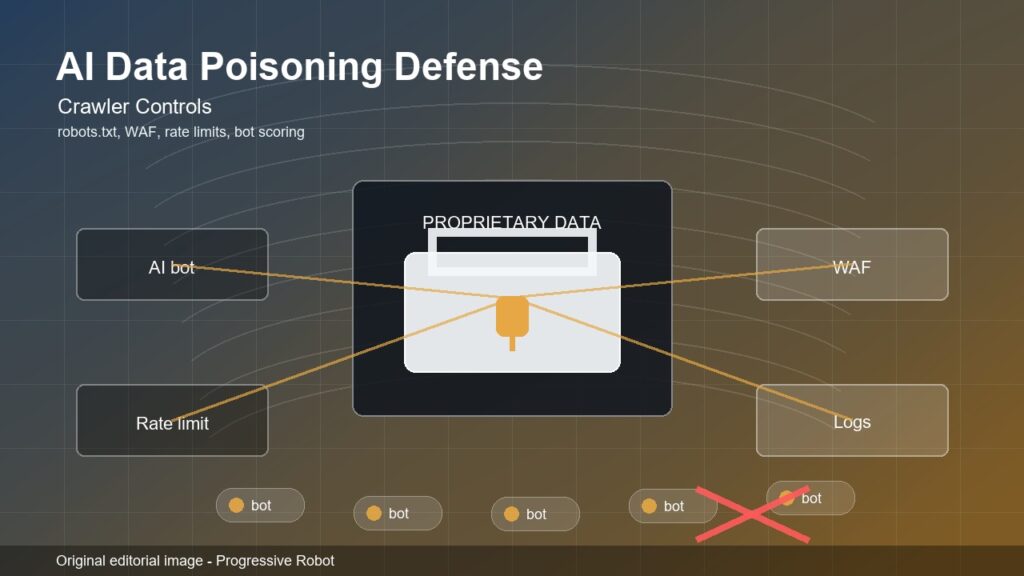
AI Data Poisoning Defense needs technical controls at the edge because polite signals are not enough. A compliant crawler may respect robots.txt or named user-agent rules. A bad scraper may ignore them, rotate infrastructure, disguise its user agent, or behave like a normal browser.
Start with robots.txt, but understand its limits. Google says its common crawlers respect robots.txt rules for automatic crawls, and its crawler documentation explains that crawlers identify themselves by user-agent, source IP, and reverse DNS. That makes crawler verification possible for known, compliant search infrastructure.
AI crawler controls should be more specific than a generic block. A practical policy might distinguish:
- search crawlers that help discovery;
- AI search crawlers that cite or link;
- AI training crawlers that collect material for model improvement;
- archivers;
- price scrapers;
- unknown bots;
- authenticated users exporting too much content.
AI Data Poisoning Defense should also use server-side enforcement. Web application firewalls, bot-management services, CDN rules, rate limits, API quotas, login throttles, browser integrity checks, and anomaly detection make it harder to collect at scale. Cloudflare’s Bot Management describes techniques such as machine learning, behavioural analysis, and fingerprinting to classify bots and stop scraping without relying only on CAPTCHA friction.
The useful controls are often simple:
| Control | What it catches | What to watch |
|---|---|---|
| Rate limits | High-volume collection | Avoid blocking real users or search indexing |
| User-agent rules | Known AI crawlers | Verify because headers can be spoofed |
| WAF rules | Suspicious paths and patterns | Keep rules tied to content classes |
| API quotas | Bulk data extraction | Separate customer use from scraping |
| Bot scores | Browser automation | Tune false positives carefully |
| Auth checks | Gated knowledge abuse | Monitor shared accounts and scripted exports |
Do not rely on a single deny list. AI crawler names change, and not every data collection pipeline announces itself honestly. Logs matter. The business should review which URLs are requested most, which IP ranges or accounts are unusual, which crawlers ignore rules, and whether blocked requests move to another path.
AI Data Poisoning Defense is strongest when bot controls are tied to business decisions. If a company wants discovery but not training, allow ordinary search and block known training crawlers. If a company has licensed one provider, allow that provider’s verified crawler and block others. If a support portal is customer-only, do not expose it to anonymous crawlers at all.
Reserve rights with contracts, metadata, and policy
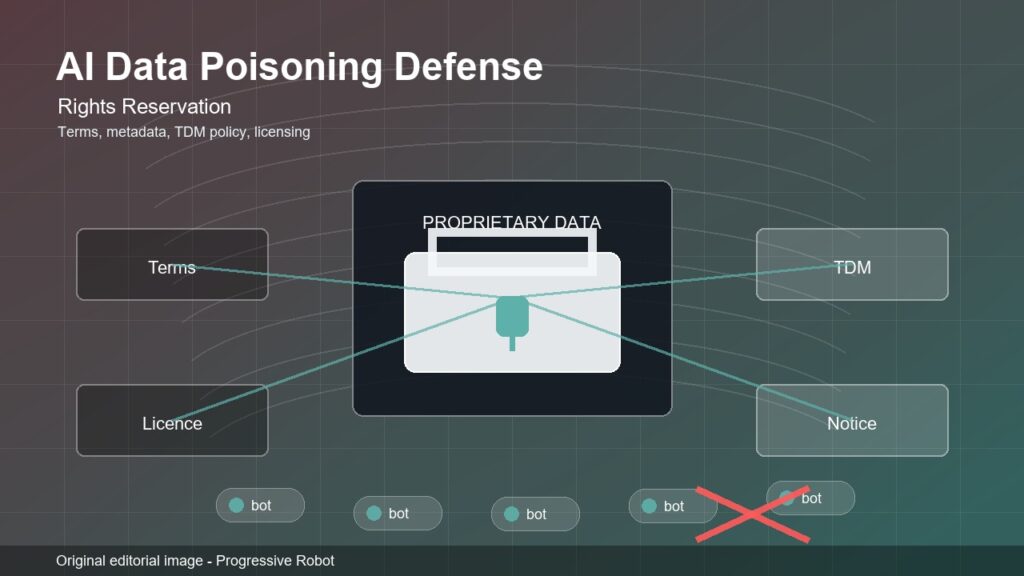
AI Data Poisoning Defense has a legal and policy layer because technical blocking cannot answer every misuse. If a competitor or model provider uses company content, the business needs to show what rights it reserved, what use it allowed, and what conduct violated those terms.
Start with terms of use. Website terms should state whether automated scraping, text and data mining, model training, dataset creation, competitive benchmarking, bulk download, or derivative model use is prohibited without written permission. Customer and partner contracts should be even clearer because they govern logged-in material.
Machine-readable rights signals are also useful. The W3C TDM Reservation Protocol defines ways to express reservation of rights for text and data mining through a tdmrep.json file, HTTP headers, HTML metadata, EPUB metadata, and PDF metadata. It describes tdm-reservation: 1 as a signal that TDM rights are reserved, with optional policy information about how to obtain permission.
AI Data Poisoning Defense should treat these signals as evidence and communication, not force fields. A rights reservation can help good-faith actors understand the rules. It can help legal teams show that use was not authorised. It can help licensing teams create a path for permission. It will not stop a scraper that chooses to ignore it.
For public company assets, a useful rights stack includes:
- clear website terms covering AI training and bulk scraping;
robots.txtentries for known AI crawlers the business does not want;- a licensing page explaining permitted and prohibited data use;
- TDM rights reservation where relevant;
- metadata in valuable PDFs, images, and downloadable files;
- contract clauses for agencies, partners, resellers, and vendors;
- a process for granting exceptions to approved AI providers.
AI Data Poisoning Defense also needs procurement discipline. If a marketing agency, web developer, marketplace, SaaS vendor, or data partner republishes company material, the contract should say whether that material can be used to train models. Many leaks are not hostile. They happen because suppliers upload files into AI tools, publish client assets in portfolios, or expose help content in third-party platforms with weaker controls.
That connects to supply chain vulnerability. A company cannot protect proprietary data from AI training if suppliers can share it freely or if partner systems expose it without the same rules.
AI Data Poisoning Defense should make authorised use easy to understand. If the business is open to licensing, say how. If it is not, say that clearly. If search indexing is allowed but training is not, separate those uses rather than blocking everything blindly.
Protect gated knowledge, files, APIs, and portals
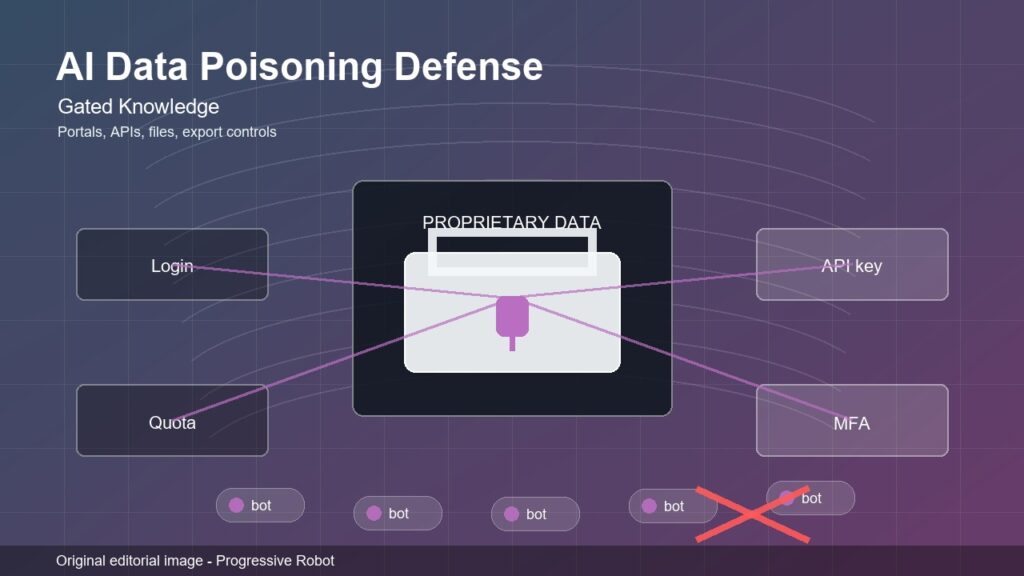
AI Data Poisoning Defense becomes much more reliable when the most valuable data is not public. This sounds obvious, but many companies put high-value material online because it improves customer support, sales conversion, or partner onboarding. The problem is not publishing. The problem is publishing without controls that match the value of the data.
Customer portals, knowledge bases, documentation sites, API endpoints, downloads, and training libraries should have explicit extraction controls. A logged-in user should not automatically be able to mirror the whole library. An API key should not automatically allow bulk export. A partner account should not automatically access every region, product, or price file.
AI Data Poisoning Defense for gated data includes:
| Asset | Risk | Control |
|---|---|---|
| Knowledge base | Bulk copying into support bot | Login, rate limits, article-level permissions |
| API | Dataset extraction | Quotas, scopes, anomaly detection, contract terms |
| PDFs | Reuse in model training | Watermarks, metadata, download logs, access expiry |
| Training videos | Transcript scraping | Stream controls, watermarking, limited download |
| Partner portal | Competitor leakage | Named users, MFA, access review, per-partner entitlements |
| Code examples | Model fine-tuning or clone tools | Repository permissions, secrets scanning, licence clarity |
Identity controls matter here. Progressive Robot’s guide to Identity-First Security is relevant because account-level protection decides who can reach sensitive content. If customer-only data is protected by shared logins, weak MFA, dormant accounts, and no export monitoring, it is not really protected from scraping.
AI Data Poisoning Defense should include device and session context for high-value portals. A normal customer reading a few articles is different from a newly created account exporting hundreds of pages through a headless browser at 3 a.m. The system should notice the difference.
APIs need special attention because they are designed for machines. Public endpoints may expose structured content in a form that is easier to train on than web pages. API docs, schema files, endpoint responses, demo datasets, autocomplete endpoints, search endpoints, and faceted filters can all become collection points.
AI Data Poisoning Defense does not mean making customers miserable. It means making bulk extraction deliberate. Use scopes, quotas, pagination limits, export approvals, contractual limits, and logs. Give legitimate customers the data they need while making full-library harvesting visible and controllable.
This is also an insurance and resilience issue. Cyber Insurance Red Flags increasingly include evidence of access control, logging, monitoring, and incident response. If proprietary data is material to the business, AI scraping should sit inside the same evidence programme.
Detect scraping with watermarking, canaries, and logs
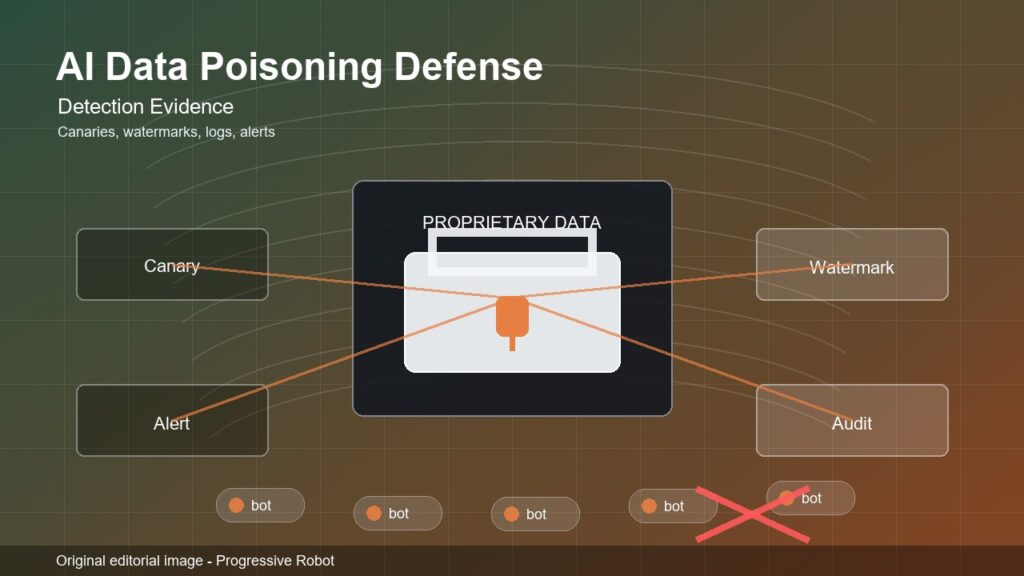
AI Data Poisoning Defense needs detection because prevention will never be perfect. Some content must remain public. Some crawlers will be allowed. Some partners will have legitimate access. Some scraping will happen before controls are improved. The business needs evidence.
Start with logs. Web server, CDN, WAF, application, API, identity, file-download, and search logs should answer basic questions: who requested what, when, how often, from where, using which account, with which user agent, and with what response code? For gated systems, logs should connect requests to users, organisations, API keys, sessions, and devices.
AI Data Poisoning Defense also benefits from canary content. A canary is a distinctive phrase, example, dummy record, synthetic support answer, invisible marker, or controlled typo that should not appear elsewhere. If it later appears in a competitor answer, generated response, copied dataset, or public web page, it can help trace origin. Canaries should be designed carefully so they do not mislead real customers or damage content quality.
Watermarking can help with documents, images, video, datasets, and exports. Visible watermarks deter casual reuse. Invisible or forensic watermarks can support investigation. Per-customer watermarks can show which account leaked a file. For structured datasets, seeded records and unique ordering can identify which export was copied.
AI Data Poisoning Defense monitoring should look for patterns such as:
- sudden spikes in page views on expert content;
- sequential requests through documentation pages;
- repeated downloads from one account or IP block;
- high-volume search queries that enumerate a knowledge base;
- API calls that walk every product or record;
- crawler user agents that ignore disallowed paths;
- new accounts behaving like automation;
- competitor domains or answer engines echoing canary phrases.
Detection should lead to action. If a scraper ignores rules, block it. If a partner account exports too much, pause it and review contract terms. If a canary appears in a model answer or competitor material, preserve evidence, involve legal counsel, and decide whether to send notice, renegotiate access, or escalate.
AI Data Poisoning Defense is not only technical forensics. It is also commercial intelligence. If a particular product category, support article, or pricing page attracts heavy AI crawler traffic, that may reveal what the market values. The business can use that information to decide what to gate, license, rewrite, summarise, or protect more strongly.
Monitoring keeps the strategy honest. Without logs and evidence, leadership is guessing. With evidence, AI Data Poisoning Defense becomes a repeatable operating process.
Where poisoning tools fit and where they do not
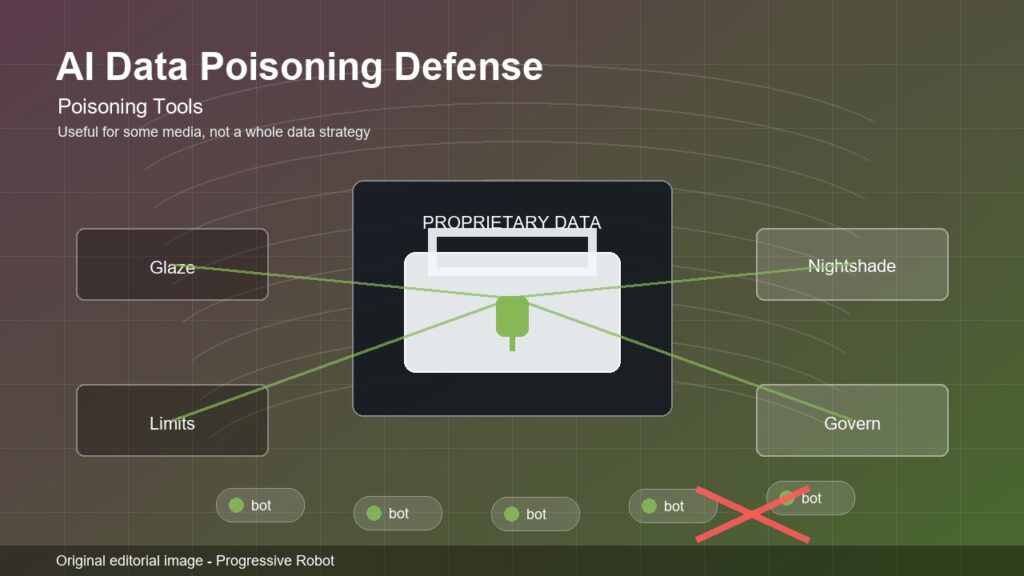
AI Data Poisoning Defense should be honest about poisoning tools. They are interesting, sometimes useful, and easy to misunderstand. They are not a universal answer for proprietary company data.
The NIST adversarial machine learning taxonomy includes data poisoning among attack and mitigation concepts in machine learning security. In simple terms, poisoning involves manipulating data so a model learns an unwanted behaviour. That can be an attack against your own models, but it can also be discussed as a deterrent against unauthorised training on your content.
For images and art, tools such as Glaze and Nightshade show what this can look like. Glaze is designed to protect artists against style mimicry by changing how AI models perceive the image while keeping it largely unchanged to human eyes. Nightshade is designed to make images unsuitable for unauthorised model training and to increase the cost of scraping unlicensed images.
Those tools are relevant to AI Data Poisoning Defense, but only in a bounded way. They mainly apply to images and creative styles, not to ordinary company text, customer knowledge bases, API responses, pricing spreadsheets, technical manuals, or internal documents. They may also be affected by future countermeasures. Even the Glaze project describes limitations and says it is not a permanent solution or panacea.
For business data, deliberate poisoning can create serious risks:
| Poisoning idea | Why it is risky |
|---|---|
| Publishing false technical guidance | Customers may follow it and suffer harm |
| Adding fake prices | Sales teams and partners may quote incorrectly |
| Corrupting documentation | Support quality falls and trust suffers |
| Inserting false data in APIs | Legitimate integrations may break |
| Seeding misleading benchmarks | Compliance, advertising, or contract risk may rise |
AI Data Poisoning Defense should therefore separate deterrence from self-harm. It is one thing to use image-specific anti-training tools on public artwork where the creator accepts the tradeoff. It is another to publish incorrect company information in the hope that a scraper consumes it. The second approach can damage customers, staff, search visibility, compliance, and brand trust.
There are safer adjacent techniques. Use canaries that do not affect meaning. Use watermarks. Use per-customer identifiers. Use licence signals. Use technical blocks. Use content summaries instead of full methods. Use gated access for high-value assets. Use synthetic examples that are clearly labelled and safe. Use contracts that prohibit model training.
AI Data Poisoning Defense should also protect the company’s own AI systems from poisoned inputs. If the business trains or fine-tunes internal models, it should validate datasets, record provenance, review labels, scan for malicious prompt content, and monitor outputs. The OWASP GenAI Security Project exists because generative AI systems introduce security risks that need structured mitigations.
The balanced view is simple: poisoning tools are a niche layer, not the foundation. AI Data Poisoning Defense should build on governance, access, rights, monitoring, and evidence first.
A 90-day roadmap and FAQ
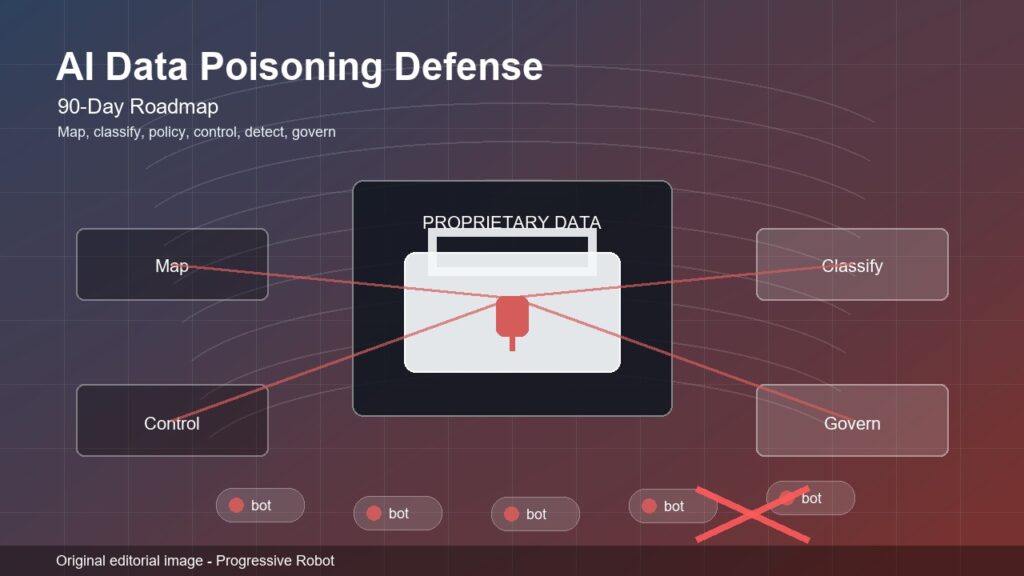
AI Data Poisoning Defense becomes manageable when leaders treat it as a 90-day exposure reduction programme rather than a vague fear about AI.
Days 1 to 15 should map valuable content. List public pages, PDFs, images, videos, APIs, documentation sites, portals, knowledge bases, code repositories, partner libraries, and data feeds. Identify what is original, proprietary, customer-sensitive, or commercially differentiating.
Days 16 to 30 should classify and assign ownership. Decide which assets are public, rights-reserved, licensed, customer-only, partner-only, internal, or restricted. Assign business owners and technical owners. Remove anything public that should never have been public.
Days 31 to 45 should update policy. Add or revise website terms, customer terms, partner clauses, API terms, and acceptable-use rules. Decide which AI crawlers are allowed, blocked, or under review. Create a licensing contact path for approved training or retrieval use.
Days 46 to 60 should implement technical controls. Update robots.txt, configure AI crawler blocks or allow lists, add WAF and rate limits, tighten API quotas, review CDN logs, and protect gated libraries with stronger identity controls.
Days 61 to 75 should add detection. Create canary phrases, watermark downloads, log exports, monitor high-value paths, and define alert thresholds. Decide who reviews scraping signals and who can block a crawler quickly.
Days 76 to 90 should test and govern. Run controlled scraping tests against public and gated content. Review logs. Confirm blocked crawlers are blocked. Confirm legitimate users still work. Prepare an evidence pack for leadership, legal, sales, and IT.
| Phase | Question | Output |
|---|---|---|
| Map | What data could train a competitor? | Exposure inventory |
| Classify | What should be public, gated, or restricted? | Data classes and owners |
| Policy | What use is allowed? | Terms, crawler policy, licensing route |
| Control | How do we enforce it? | Bot, WAF, access, API controls |
| Detect | How will we know if it happens? | Logs, canaries, watermarks, alerts |
| Govern | Who owns ongoing decisions? | Review rhythm and evidence pack |
AI Data Poisoning Defense should then become part of normal publishing. Every new guide, dataset, API, portal, and downloadable file should pass the same question: would we be comfortable if this trained a competitor model?
What is AI Data Poisoning Defense?
AI Data Poisoning Defense is the practice of protecting proprietary company data from unauthorised AI scraping, model training, dataset creation, and competitor reuse. It includes access control, crawler management, rights reservation, monitoring, watermarking, and careful use of poisoning-style deterrents where appropriate.
Should companies poison their own website content?
Usually no. Publishing false or corrupted information can hurt customers, staff, search visibility, compliance, and brand trust. AI Data Poisoning Defense should prioritise prevention, rights signals, gated access, monitoring, and safe canaries before considering any poisoning technique.
Do robots.txt files stop AI companies from training on content?
They can stop compliant crawlers that choose to respect them, but they do not physically prevent scraping. AI Data Poisoning Defense should combine robots.txt with server-side enforcement, bot controls, contracts, monitoring, and rights notices.
What company data is most at risk?
High-value public or semi-public material is most at risk: technical guides, support articles, pricing detail, original images, research reports, product databases, API responses, templates, training materials, and partner documentation.
Are Glaze and Nightshade suitable for business data?
They are mainly designed for image and artwork protection. They may be useful for creative assets, but they do not solve scraping risk for ordinary company text, databases, customer portals, or internal documents.
What is the safest first step?
Map what is public. Many companies discover old PDFs, staging pages, docs sites, or file links that reveal more than intended. AI Data Poisoning Defense starts by finding and classifying that exposure before buying tools.
How does this relate to AI governance?
AI governance is not only about how a company uses AI internally. It is also about how the company’s data may be used by others. AI Data Poisoning Defense gives governance teams a practical way to control data exposure, permissions, and evidence.
Can SMEs do this without a large security team?
Yes. Start narrow. Protect the most valuable public and gated content first, add clear terms, block obvious AI training crawlers, review logs, strengthen portal access, and create a simple owner-based process for new content.
AI Data Poisoning Defense is ultimately about control. Competitors should not get a free training advantage from material your company created, refined, funded, and depends on. The strongest protection is not theatrical poisoning. It is knowing what you own, deciding how it may be used, enforcing that decision technically, and keeping enough evidence to act when the line is crossed.










