
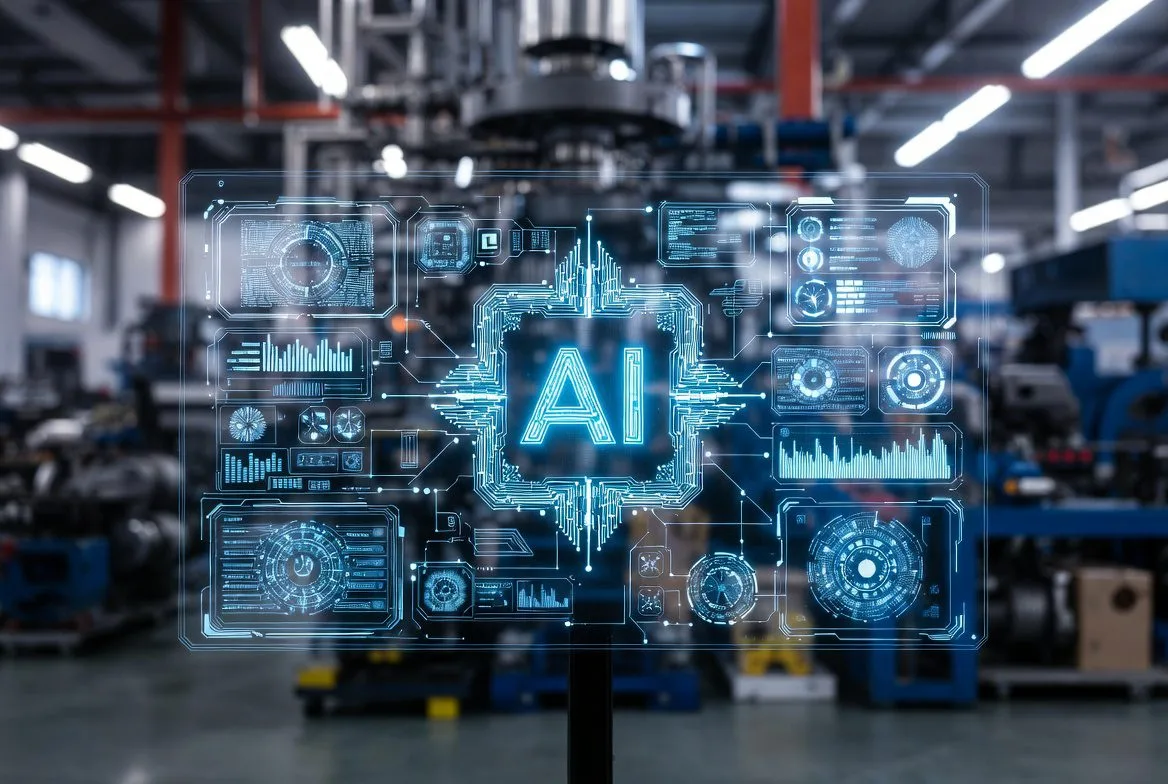
In today’s volatile global economy, manufacturers confront intensified competition alongside disruptions from geopolitical tensions, fluctuating trade policies, and unpredictable tariffs. These factors frequently interrupt supply chains, elevate material costs, and impose obstacles to market access and growth. Amid such instability, enhancing production efficiency emerges as a primary strategy for revenue growth and long-term sustainability. Manufacturers increasingly rely on data and AI in manufacturing to streamline core operations, turning potential vulnerabilities into competitive advantages.
By harnessing historical and real-time production data, AI-powered systems identify inefficiencies, forecast equipment failures, and minimise unplanned downtimes. This proactive approach not only stabilizes operations but also enables manufacturers to navigate economic pressures with greater agility. Recent insights from Deloitte’s 2025 Manufacturing Industry Outlook indicate that a significant portion of industrial manufacturers actively employ generative AI tools in their operations, with many planning substantial increases in AI and machine learning investments over the coming years. Such adoption reflects a broader industry shift toward intelligent technologies that deliver measurable improvements in cost control and output quality.
Machine learning models within data and AI in manufacturing continuously track production variables and make automatic adjustments to curb process variations and defects. This ensures consistent adherence to quality benchmarks while pinpointing patterns that contribute to waste or inconsistencies. As a result, manufacturers reduce scrap rates, strengthen quality assurance protocols, and optimise resource utilisation. Beyond immediate efficiency gains, these technologies foster adaptive systems that future-proof operations against ongoing uncertainties.
Solidifying Industry 4.0 Progress with Data and AI in Manufacturing

The foundational elements of Industry 4.0, including the Internet of Things, artificial intelligence, and data analytics, have long demonstrated value through smarter workflows, predictive maintenance, and superior product quality. However, initial investments in sensors, infrastructure, and system integrations pose significant hurdles, particularly for small and medium-sized enterprises.
Employee upskilling adds further complexity to these transformations. Despite these barriers, the return on investment manifests in real-time insights, cost reductions, revenue enhancements, improved workforce satisfaction, and strengthened market positioning.
The path to realising this value often proves gradual rather than instantaneous, challenging organisations to secure early buy-in. Successful digital transformations in manufacturing typically commence with targeted pilot initiatives that focus on high-impact areas, such as automating quality checks or lowering scrap percentages.
These focused efforts generate tangible results swiftly, mitigating risks and building momentum for wider rollout. This incremental methodology has emerged as a recommended practice, allowing manufacturers to harness the full potential of IoT and data and AI in manufacturing without overwhelming upfront expenditures.
Standardisation Keeps Smart Factories Running Securely

Interoperability among machines, devices, and systems remains essential for effective smart manufacturing, yet it simultaneously introduces cybersecurity vulnerabilities. In connected factories, protection extends beyond traditional IT concerns to encompass the entire operational ecosystem. Standardisation plays a pivotal role here by unifying processes, workflows, and methodologies across production environments.
Consistent standards for data formats, communication protocols, and integrations enable seamless scaling, cross-system collaboration, and enduring viability of digital projects. Without such uniformity, even cutting-edge deployments struggle to deliver sustained benefits. As connectivity proliferates through sensors and interconnected equipment, cybersecurity demands heightened attention. Manufacturers must construct resilient architectures grounded in deep knowledge of industrial systems, evolving threat landscapes, and secure-by-design principles. This foundation includes anticipating potential weaknesses, formulating regulation-compliant strategies, and adapting to new attack vectors. Absent robust defenses, heightened connectivity can paradoxically increase exposure.
Preparing Data to Support Advanced Technologies

Addressing core challenges in manufacturing—ranging from high costs of IoT and AI deployments to standardisation gaps and cybersecurity threats—starts with a thorough evaluation of the existing data ecosystem. This assessment examines data collection methods, storage practices, integration mechanisms, and governance structures to reveal deficiencies, redundancies, and overlooked opportunities.
Rather than rushing to deploy new hardware or sensors, organisations should first extract maximum value from current datasets. Frequently, solutions to persistent issues like efficiency bottlenecks, excess waste, or quality fluctuations reside within untapped internal data. Applying established analytical methods and AI models uncovers these insights rapidly, yielding quick wins with limited operational interference.
While digital twins represent a prominent application, tailored data strategies aligned with specific technical constraints and business objectives often prove more effective.
Establishing solid data architectures, governance policies, and adherence to industry standards converts raw information into a dependable, scalable, and protected resource. Such readiness empowers data and AI in manufacturing to drive genuine efficiency improvements and resilient smart factory environments.
Data Quality Outweighs Quantity in Manufacturing Transformations

Central to this preparation lies rigorous data quality evaluation, which determines completeness, accuracy, reliability, and relevance for decision-making purposes. Global assessments reveal that only a small fraction of organisations achieve exemplary standards in this area. A recent study from Precisely and Drexel University’s LeBow College of Business found that 77 percent of organisations characterize their data quality as average at best, underscoring widespread shortcomings.
High-quality data serves as the bedrock for effective analytics and artificial intelligence initiatives. Superior accuracy and context transform raw data into meaningful information, which in turn builds actionable knowledge through pattern recognition and relationships. Without reliable foundations, advanced technologies cannot function optimally. In essence, robust data and AI in manufacturing depends entirely on trustworthy inputs.
Data-Driven Manufacturing as the New Industry Standard

Data-driven manufacturing integrates real-time insights, pervasive connectivity, and artificial intelligence to enhance traditional decision-making throughout the product lifecycle. It draws from internal production sources and external signals to guide processes from design conception through delivery and post-sales support.
This paradigm relies on continuous data streams from sensors, IoT devices, and operational systems, coupled with advanced analytics for predictive and prescriptive guidance. Seamless integration spans shop floor activities, supply chain logistics, and strategic planning, while visualization platforms such as dashboards and digital twins render complex information accessible and actionable.
On the shop floor, real-time analytics facilitate bottleneck identification, workflow optimisation, and productivity elevation while curtailing downtime. Predictive maintenance capabilities, powered by data and AI in manufacturing, can decrease equipment failures substantially and lower associated costs significantly. These improvements contribute to sustained operational excellence amid economic fluctuations.
Quality enhancement and innovation also benefit profoundly. Early defect detection supports continuous refinement, while usage pattern analysis informs future product iterations. Collectively, these elements position manufacturers to respond dynamically to market shifts.
Integrating AI Safely and Effectively into Production

As digitalization accelerates, the focus has evolved from feasibility to optimal placement of AI capabilities within manufacturing environments. Embedded AI and edge computing emerge as key enablers, relocating intelligence directly to the production line for accelerated responses, greater autonomy, and diminished reliance on distant infrastructure.
AI at the Edge: Bringing Intelligence Closer to Operations

Conventional approaches transmit machine-generated data—encompassing vibrations, temperatures, torque, audio, and pressure—to centralised or cloud-based systems for processing. Although productive, this method introduces latency, bandwidth expenses, and security considerations. In high-speed production settings, even minor delays in anomaly detection or process correction can amplify scrap, downtime, and quality issues.
To counter these limitations, industry momentum builds toward deploying AI and machine learning directly on edge devices near data origins. This strategy excels in predictive maintenance, instantaneous anomaly identification, quality verification, and process fine-tuning. Edge computing decentralizes data handling, aligning with the reality that most information emerges outside traditional data centers.
Market projections underscore this trajectory, with the global edge computing sector anticipated to expand significantly in the coming years. Edge-based systems enable immediate anomaly spotting, performance deviation recognition, and on-the-spot decision execution without off-site transmission.
Embedded AI facilitates predictive and autonomous functions. For example, models running on line-adjacent devices analyse sensor feeds to detect early indicators of faults in motors or cycles, triggering alerts or automated interventions to avert disruptions. Continuous model refinement occurs through periodic updates from centralised repositories, blending broad learning with localized performance.
Partnering with Specialists for Successful Implementation

Achieving smart factory maturity requires deliberate progression rather than abrupt overhauls. Manufacturers balancing ongoing production with transformation initiatives benefit from commencing with focused edge AI projects that demonstrate clear value.
Experienced teams specialising in data engineering, artificial intelligence, and embedded systems provide customised solutions to elevate operations, increase output, and unlock additional revenue streams. Such partnerships accelerate adoption while ensuring alignment with strategic objectives.
In summary, data and AI in manufacturing represent essential tools for thriving amid persistent market uncertainties and economic headwinds. By prioritising data readiness, embracing standardisation, fortifying cybersecurity, and strategically deploying edge intelligence, manufacturers build resilient, efficient operations capable of sustained growth and innovation.










