
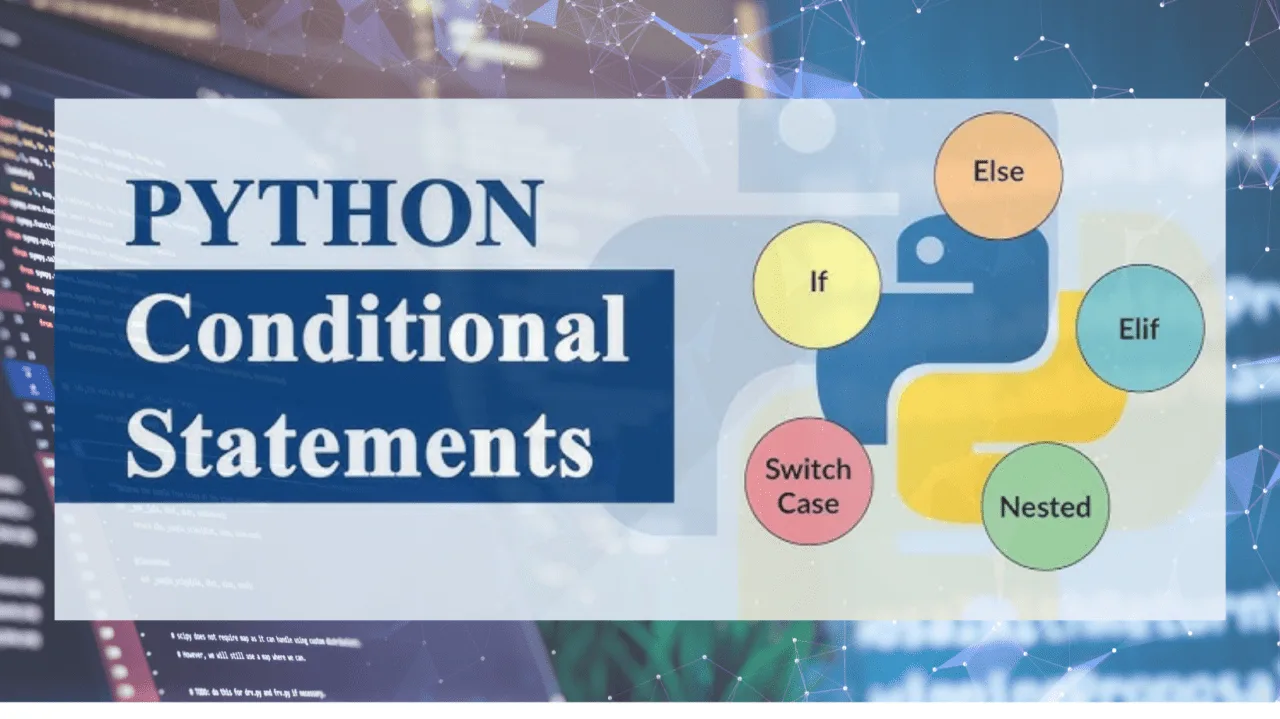
Learning how to write conditional statements in Python 3 is one of the most fundamental and frequently used skills in programming — conditional statements (if, elif, else) let your program make decisions, control flow, validate input, handle different cases, and respond intelligently to data, making them essential for almost every real-world Python script (games, automation, web apps, data analysis, CLI tools, AI logic).
In this up-to-date 2025–2026 guide, you’ll master exactly how to write conditional statements in Python 3: basic if, elif, else, nested conditionals, logical operators (and, or, not), truthy/falsy values, chaining comparisons, best practices, and common patterns. All examples are tested on Python 3.10–3.13.
Key Takeaways – Conditional Statements in Python 3
- Conditional statements in Python 3 use if, elif, else to execute code only when a condition is True.
- Conditions evaluate to Boolean (True/False) using comparison operators (==, !=, >, <, >=, <=).
- Logical operators: and (both true), or (at least one true), not (invert).
- Truthy values (non-zero, non-empty) evaluate to True; falsy values (0, “”, [], {}, None, False) to False.
- Use parentheses for clarity in complex conditions.
- Prefer if value: over if value == True: — more Pythonic.
- Chaining: 1 < x < 10 is valid and readable.
Prerequisites
- Python 3.8+ installed
- Basic Python knowledge (variables, print)
- Interactive shell (python3) or script file
1. Basic if Statement in Python 3
					grade = 70

if grade >= 65:
    print("Passing grade")

# No output if condition is False
grade = 60
if grade >= 65:
    print("Passing grade")  # nothing prints
2. if … else Statement
					balance = -5

if balance < 0:
    print("Balance is below 0 – add funds or penalty!")
else:
    print("Balance is 0 or above.")
3. if … elif … else Chain
					grade = 82

if grade >= 90:
    print("A")
elif grade >= 80:
    print("B")
elif grade >= 70:
    print("C")
elif grade >= 65:
    print("D")
else:
    print("Failing grade")
4. Nested Conditional Statements
					grade = 92

if grade >= 65:
    print("Passing grade of:")
    if grade >= 90:
        if grade >= 97:
            print("A+")
        elif grade >= 93:
            print("A")
        else:
            print("A-")
    elif grade >= 80:
        print("B")
    # ... more elifs
else:
    print("Failing grade")
5. Logical Operators – and, or, not
					age = 17
has_id = True

if age >= 18 and has_id:
    print("Access granted")
else:
    print("Access denied")

# Short-circuit evaluation
user_input = ""
if user_input and int(user_input) > 0:
    print("Positive number")  # safe – doesn't crash on empty string
6. Truthy & Falsy Values
					print(bool(0))          # False
print(bool(""))         # False
print(bool([]))         # False
print(bool(None))       # False
print(bool(42))         # True
print(bool("text"))     # True
print(bool([1,2]))      # True

# Common idiom
data = []
if not data:
    print("No data available!")
7. Chained Comparisons
					x = 7
print(1 < x < 10)      # True
print(5 < x < 6)       # False
8. Best Practices & Modern Tips (2025–2026)
- Use if value: instead of if value == True:
- Prefer chaining: if 18 <= age <= 65: over age >= 18 and age <= 65
- Use parentheses for complex logic: if (a > b) and (c < d):
- Add type hints: def check_age(age: int) -> str:
- Avoid deeply nested ifs — refactor into functions or use early returns
- Use guard clauses: if not user_input: return “Error”
How to Write Conditional Statements in Python 3 – FAQ (2025–2026)
- How do I write conditional statements in Python 3?
Use if, elif, else — basic structure for conditional statements in Python 3. - What’s the difference between if, elif, and else in Python 3?
if first check; elif additional checks; else catch-all. - How do logical operators work in conditional statements in Python 3?
and (both true), or (at least one true), not (invert) — key to conditional statements in Python 3. - What are truthy and falsy values in Python 3?
Truthy: non-zero/non-empty; Falsy: 0, “”, [], {}, None, False. - Can I chain comparisons in conditional statements in Python 3?
Yes — 1 < x < 10 is valid and clean.
Summary
You now know exactly how to write conditional statements in Python 3: basic if/elif/else, nested conditionals, logical operators, truthy/falsy values, chaining, and modern best practices.
Mastering conditional statements in Python 3 gives your programs decision-making power — validation, flow control, error handling, filtering, and intelligent behaviour. It’s the foundation of almost every non-trivial Python script.
Recommended Next Tutorials
- Python Loops (for, while) with Conditional Statements
- Python Exception Handling (try/except) & Conditions
- Python Ternary Operator (Conditional Expression)
- Build a Grade Calculator / Login Validator with Conditionals
- Python Match-Case (Structural Pattern Matching – Python 3.10+)










