
When hiring software development teams, businesses today have several engagement models to choose from: outsourcing, outstaffing, or even a dedicated team approach. Each model comes with unique benefits and challenges, making the choice highly dependent on a company’s goals, resources, and technical expertise.
Outsourcing or Outstaffing are among the most popular approaches. Businesses that opt for outsourcing typically don’t have an in-house development team or find their existing team too small to complete a project on time. In this case, they transfer the entire development process and project management to an external outsourcing provider. On the other hand, when a company already has an in-house team but lacks certain skills or technologies, they often choose outstaffing. This allows them to bring in additional resources from a provider while maintaining full control over the project internally.
The big question for many organisations is simple: Outsourcing or Outstaffing — which one to choose? To answer this, we need to dive deep into how each model works, explore their benefits, and understand which situations each best suits.
The Growing Relevance of Outsourcing and Outstaffing

Software development outsourcing is not new. In fact, it has been in the spotlight for decades. According to Statista, IT outsourcing generated over 351 billion U.S. dollars in revenue in 2021, and the demand for outsourcing services grew even further due to the COVID-19 pandemic, when many companies had to adapt to remote operations.
Outstaffing, by contrast, is a newer concept but has quickly gained traction. Both outsourcing and outstaffing promise cost savings, access to global talent, and greater flexibility. However, the way they are structured — and the degree of control they give to the client — makes them fundamentally different.
Before we compare them head-to-head, let’s first explore each model in detail.
What is Software Development Outsourcing?

In outsourcing, a company hires a software development provider and delegates the entire project to that provider. The outsourcing company takes full responsibility for development, management, quality assurance, and delivery.
This doesn’t necessarily mean working with a company abroad. Outsourcing can be done onshore (same country), nearshore (neighboring country), or offshore (a distant country offering cost advantages). The choice depends on the client’s budget, timeline, and preferences.
Benefits of Outsourcing
Companies that choose outsourcing enjoy several advantages. First and foremost, outsourcing provides access to skilled expertise without the need to hire full-time employees. Businesses can scale their operations quickly and flexibly, adding or reducing resources based on project needs.
Cost reduction is another powerful motivator. By outsourcing to regions with lower labour costs, companies can save significantly while still maintaining high quality. Additionally, outsourcing reduces overhead costs, as the provider handles infrastructure, HR, and administrative work.
Another key benefit is efficiency. With a dedicated provider handling the project, businesses can focus on core activities such as marketing, sales, or customer support, while leaving technical execution to professionals.
How Outsourcing Works in Practice
When outsourcing, most communication and project management responsibilities lie with the provider’s project manager. The client typically has limited direct access to developers, as those resources may be shared across multiple projects.
At the end of the cycle, the client receives a turnkey solution. While this saves time and effort, there is a potential downside: costs can sometimes exceed the initial estimate, especially if the project scope changes or if the chosen engagement model lacks transparency.
For long-term or large-scale projects, companies often adopt an Offshore Development Center (ODC) model, which offers more stability and dedicated resources compared to traditional outsourcing.
What is the Outstaffing Model?

Outstaffing, on the other hand, works differently. Instead of handing over the entire project, the client extends its team with remote specialists who are officially employed by the outstaffing provider. These professionals work 100% dedicated to the client’s project as if they were in-house employees.
The client maintains full control over the development process, managing tasks, priorities, and deadlines. The provider’s role is primarily administrative — hiring, HR, payroll, and ensuring smooth collaboration.
Benefits of Outstaffing
The outstaffing model offers unique benefits. Because the client manages the remote team directly, they retain complete control over code quality and project management. This ensures transparency and alignment with internal processes.
Outstaffing also enables significant cost savings, as businesses avoid the expenses of recruiting, training, and maintaining full-time staff. It also allows companies to access a wider pool of talent, adding niche expertise like AI, machine learning, IoT, or blockchain development without long-term commitments.
Flexibility is another advantage. Companies can scale their teams up or down quickly based on project demands, which makes outstaffing highly suitable for businesses that need agility.
Outsourcing vs. Outstaffing: Key Differences
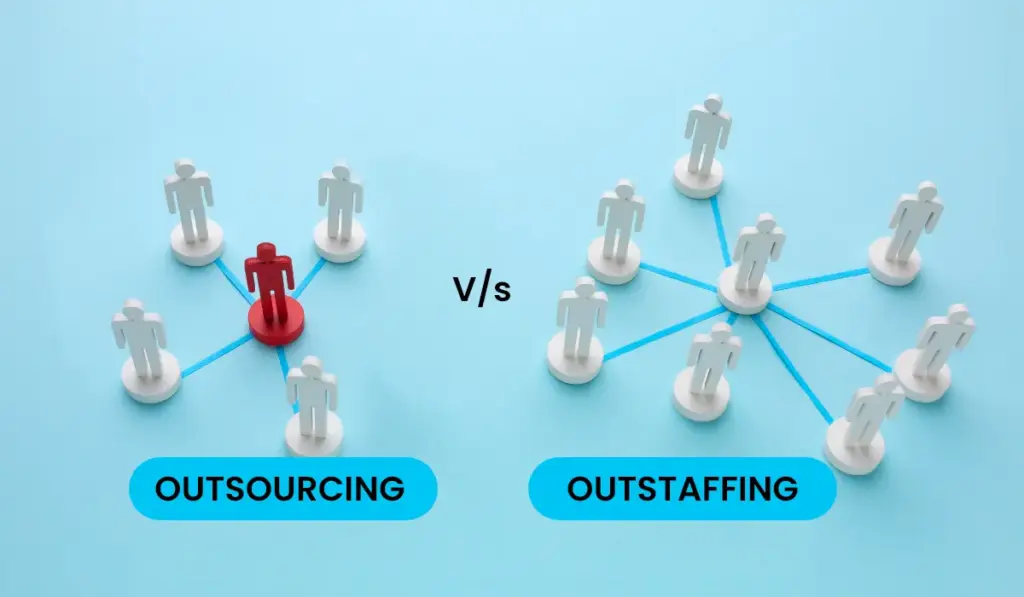
The terms outsourcing and outstaffing are often confused, but they are not interchangeable. While both models deliver cost savings and global expertise, their application differs.
The main distinctions can be summarized as follows:
Control: In outsourcing, the provider manages the project; in outstaffing, the client manages the team.
Cost Structure: Outsourcing may involve hidden costs or changes in scope, while outstaffing usually offers transparent pricing for dedicated resources.
Team Access: Outsourcing clients often interact with a project manager, not the developers. Outstaffing clients directly communicate with and manage the remote team.
Use Cases: Outsourcing is ideal for companies without technical expertise; outstaffing is perfect for companies with in-house teams that need extra talent.
In other words, Outsourcing or Outstaffing should be chosen based on your company’s size, technical capacity, and project goals.
Which Model Should You Choose?
The decision between Outsourcing or Outstaffing often boils down to a few critical questions:
Who is responsible for code quality?
Who manages the project?
What is the budget, and which option is cheaper long-term?
Who is involved in hiring and team selection?
For example, a startup with no in-house development resources and a tight deadline would benefit more from outsourcing. The outsourcing provider can quickly assemble a team, ramp up development, and deliver the project with minimal management effort from the client.
By contrast, a company that already has a development team but needs additional expertise — say, integrating AI or IoT features — would find outstaffing more beneficial. They can expand their team with external experts while maintaining full control of workflows.
Case Scenarios
Startup Example: A fintech startup needs a mobile app built within three months but lacks developers. Outsourcing is the best option because it ensures speed, expertise, and minimal management load.
Established Company Example: An e-commerce business already has a 20-person development team but needs blockchain integration. Outstaffing provides access to blockchain experts without restructuring their existing team.
These examples highlight why it’s not a question of which model is better overall, but rather which one fits your specific business case.
The Bottom Line
Choosing between Outsourcing or Outstaffing is not a one-size-fits-all decision. Outsourcing works best for businesses that need a complete solution delivered without investing in internal development capabilities. Outstaffing, meanwhile, suits companies that already have an in-house team but require specialised skills or scalability without the long-term overhead of hiring.
At Progressive Robot, we offer both outsourcing and outstaffing services. Our experts help businesses evaluate their needs, define goals, and select the engagement model that maximizes efficiency, cost-effectiveness, and results. Whether you need an end-to-end solution or just a few highly skilled developers, Progressive Robot is ready to provide the right fit.










