
The debate on Functional Programming vs Object-Oriented Programming (FP vs OOP) has been ongoing for decades in the software development world. Both paradigms aim to help developers build flexible, maintainable, and bug-free applications, but they take very different approaches.
Choosing the right paradigm is crucial because it directly impacts project scalability, code readability, performance, and team productivity. In this guide, we’ll explore the differences between functional and object-oriented programming, their pros and cons, and help you decide which one is the best fit for your project.
What Is Object-Oriented Programming (OOP)?
Object-Oriented Programming is a programming paradigm built around the concept of objects, which combine both data (attributes) and behaviour (methods) in one place. This makes OOP intuitive because it models real-world entities in software.
OOP is based on four core principles:
Abstraction – Hides unnecessary details while focusing on the essential aspects of the program.
Encapsulation – Protects data by restricting direct access and exposing it only through defined methods.
Inheritance – Allows one class to inherit fields and methods from another, promoting reusability.
Polymorphism – Lets different objects respond to the same method in their own way.
Example: In a banking application, a Customer object may contain attributes like name and balance, while methods like deposit() or withdraw() define its behaviour.
Advantages of OOP
Encapsulation & security – Prevents unauthorized access to data.
Code reusability – Classes and objects can be reused across projects.
Scalability – Easier to manage and extend large applications.
Modularity – Encourages separation of concerns through independent modules.
Disadvantages of OOP
Complexity – Designing classes for large systems can be difficult.
Performance overhead – Object management can consume extra resources.
Tight coupling – Functions tied to specific classes are less reusable in other contexts.
What Is Functional Programming (FP)?
Functional Programming is a paradigm that focuses on pure functions, immutability, and mathematical transformations. Unlike OOP, FP treats data and behaviour as separate entities. Instead of modifying objects, new values are created through function calls.
Core concepts of FP include:
Pure functions – Functions always return the same output for the same input, with no side effects.
Higher-order functions (HOFs) – Functions that take other functions as parameters or return them.
Immutability – Once a variable is created, it cannot be changed.
Recursion – Loops are replaced with recursive function calls.
Referential transparency – An expression can be replaced with its value without affecting the program.
Lazy evaluation – Values are computed only when needed.
Example: In FP, instead of updating a customer’s balance directly, a function would return a new balance based on the old one without mutating the original data.
Advantages of FP
Cleaner, concise code – Programs are shorter and easier to debug.
Bug reduction – Pure functions eliminate unexpected side effects.
Parallel programming – Immutability makes it easier to handle multi-threaded applications.
Predictable behaviour – Functions are independent and predictable.
Disadvantages of FP
Learning curve – Requires a different mindset compared to OOP.
Fewer developers & resources – Smaller community compared to OOP.
Not always intuitive – Harder for beginners to map real-world scenarios.
Key Differences: Functional Programming vs Object-Oriented Programming
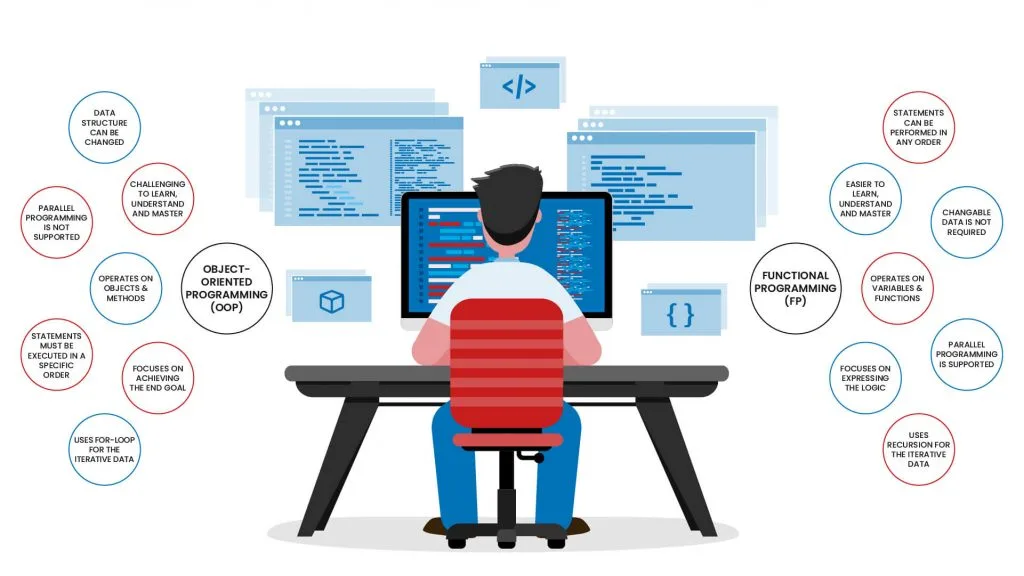
Now that we’ve covered the basics, let’s look at the main differences between functional programming and object-oriented programming:
| Feature | Object-Oriented Programming (OOP) | Functional Programming (FP) |
|---|---|---|
| Core Concept | Objects combine data + behaviour | Functions operate on immutable data |
| Data Handling | Mutable (can change state) | Immutable (data never changes) |
| Approach | Focuses on how to perform tasks | Focuses on what to perform |
| Code Reuse | Inheritance & polymorphism | Higher-order functions & recursion |
| Best For | Applications with evolving data types (e.g., social networks, marketplaces) | Applications with clear operations & transformations (e.g., mathematical models, financial apps) |
Functional Programming vs Object-Oriented Programming: Which One Should You Choose?
The choice between functional programming vs object-oriented programming depends entirely on your project requirements:
Choose OOP when:
Your project involves complex entities with changing states.
You need modular and reusable components.
Real-world modelling is essential (e.g., e-commerce, CRMs, social platforms).
Choose FP when:
You want concise, bug-free, and testable code.
Your project involves data processing, AI, or mathematical calculations.
You need high parallel processing performance.
As Norman Ramsey, professor at Tufts University, summarized:
OOP works best when behaviours are fixed but data types evolve.
FP works best when data types are fixed but behaviours evolve.
Can You Combine OOP and FP?
Yes! In fact, modern programming languages like JavaScript, Python, and Scala allow developers to use both paradigms. Combining functional programming and object-oriented programming can deliver:
More flexibility in handling different problem types.
Cleaner separation between data models (OOP) and business logic (FP).
Easier testing and maintenance.
For example, a web app might use OOP for managing user accounts and profiles, while applying FP for data filtering, analytics, or recommendation algorithms.
Conclusion

The Functional Programming vs Object-Oriented Programming debate isn’t about which is universally better, but about choosing the right tool for the job.
Use OOP when your project needs strong data modelling, encapsulation, and scalability.
Use FP when you need concise, predictable, and performance-oriented code.
Or, combine both to get the best of both worlds.
At Progressive Robot, we help businesses make the right technology decisions and deliver solutions that are secure, scalable, and future-ready.
Need help choosing between functional programming and object-oriented programming for your project? Contact Progressive Robot today!