
NFT aggregator marketplace development has become one of the hottest topics in the Web3 space as the NFT ecosystem matures in 2025. From 2021 to 2025, the NFT market has experienced countless ups and downs. Some predicted the inevitable end of this trend, while others believed that the decline was merely an adjustment after the initial hype.
Nonetheless, the buzzword implying ownership of digital artwork, music, trading cards, or gaming artifacts is forecasted to reach $504.3 million in revenue in 2025. And some prominent collectible projects, such as CryptoPunks and Bored Ape Yacht Club (BAYC), still rank among the top 50 NFTs based on market cap.
As interest continues, users increasingly seek better tools to search, compare, and trade digital assets across multiple marketplaces. This is where NFT aggregator marketplaces step in — offering a one-stop hub for NFT discovery and transactions.
How NFT Aggregator Marketplaces Work
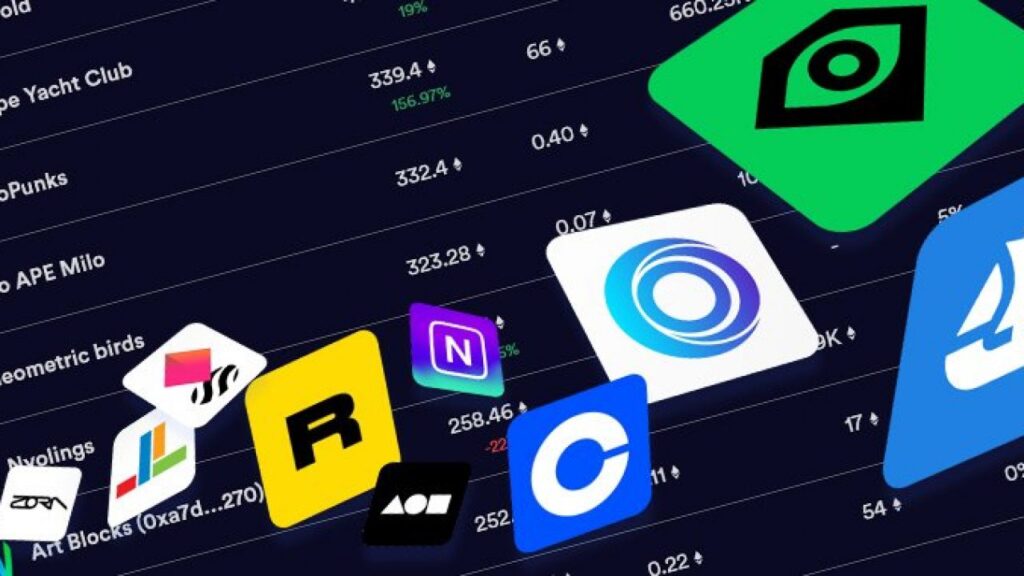
NFT aggregator marketplaces are platforms that collect listings from multiple NFT marketplaces and present them in one place.
Instead of opening OpenSea, Blur, Magic Eden, and other platforms separately, users can simply visit an aggregator to check every detail of NFTs, including:
Prices
Availability
Ownership history
Traits and rarity
Example: If someone is looking for a rare Bored Ape Yacht Club NFT, they no longer need to check multiple sites. On an aggregator, they type “Bored Ape” and instantly see listings from all integrated marketplaces.
NFT Aggregator vs. Traditional NFT Marketplaces
| Aspect | Aggregator Marketplace | Traditional Marketplace |
|---|---|---|
| Listings | From multiple marketplaces | From its own sellers |
| Variety | Wide range, multi-blockchain | Limited to platform’s scope |
| Price Check | Real-time cross-platform comparison | No cross-platform view |
| User Journey | One-stop search and purchase | Browse multiple sites |
| Competition | Less crowded market | Highly saturated |
Benefits of Building NFT Aggregator Marketplaces for Businesses
For businesses entering the NFT space, creating an aggregator is a high-potential niche. Unlike traditional marketplaces, the aggregator market is less saturated and offers unique opportunities.
Key benefits include:
Broader Audience from Day One: Access to listings across multiple marketplaces increases appeal.
Central Hub Positioning: Like flight comparison sites in travel, aggregators become the default starting point for NFT trading.
Revenue Potential: Earn from transaction fees, affiliate partnerships, analytics subscriptions, paid ads, or loyalty programs.
Market Insights: User searches, trends, and transactional data provide valuable intelligence.
Liquidity Advantage: Aggregating listings solves the liquidity problem most NFT businesses face.
Key Features of a Successful NFT Aggregator Marketplace
A strong NFT aggregator should provide much more than just listings. Essential features include:
Cross-Marketplace Search & Filtering: Search by keywords, collections, or token IDs; filter by rarity, blockchain, price, or auction type.
Live Pricing & Rarity Tracking: Real-time updates of floor prices, recent sales, and rarity scores.
Gas Fee Optimization: Reduce costs with bundled transactions, sidechains (e.g., Polygon), or smart routing.
Multi-Wallet Integration: Support for MetaMask, Coinbase Wallet, WalletConnect, and hardware wallets.
Portfolio Management: View owned NFTs, track valuations, set alerts, and export transaction history.
In-Depth Analytics: Collection charts, volume trends, rarity-based sales data, and AI-powered predictions.
AI Recommendations: Suggest NFTs and collections based on browsing and wallet activity.
White-Label vs. Custom NFT Aggregator Development
When building an NFT aggregator marketplace, businesses can choose white-label solutions or custom development.
White-Label NFT Aggregator Development
Quick Launch – Go live in weeks.
Lower Costs – Pre-built core features.
Trusted Technology – Proven solutions.
Easier Maintenance – Updates handled by provider.
Limitation: Low customization and difficulty standing out.
Custom NFT Aggregator Development
Unique Features – Custom search tools, AI, analytics.
Flexible Integrations – Connect to new or niche marketplaces.
Optimized Performance – Efficient, gas-friendly infrastructure.
Future Growth – Add features as demand evolves.
Trade-off: Higher cost and longer development time.
Challenges in Building NFT Aggregator Platforms
While lucrative, NFT aggregators face several challenges:
API Limitations – Marketplace APIs may be incomplete or restrictive.
Blockchain Congestion – High traffic increases transaction costs.
Data Freshness – Prices change rapidly; stale data can mislead users.
Compliance Issues – Different jurisdictions impose trading and AML requirements.
Cost of NFT Aggregator Marketplace Development
The cost to build an NFT aggregator depends on scope, features, and development approach:
White-Label Solution: $10,000 – $50,000
Custom Development: $50,000 – $200,000+
Additional cost factors:
Blockchain integrations
Security & compliance
UX/UI design
Maintenance & scaling
Why Choose Progressive Robot for NFT Aggregator Marketplace Development
Developing an NFT aggregator requires deep expertise in blockchain, APIs, and Web3 ecosystems.
At Progressive Robot, we bring:
25+ years of software development experience
Specialization in blockchain and NFT solutions
Expertise in multi-chain integration, gas optimization, and live data feeds
End-to-end support: from concept and design to launch and maintenance
With Progressive Robot, you gain a partner who understands the unique needs of NFT aggregators and can build scalable, secure, and profitable platforms for 2025 and beyond.
Frequently Asked Questions (FAQs)
1. What is an NFT aggregator marketplace?
It’s a platform that aggregates NFT listings from multiple marketplaces into one interface for easier search and comparison.
2. How do NFT aggregators make money?
Through transaction fees, commissions, premium subscriptions, advertising, and reward schemes.
3. What are the main challenges?
API limits, blockchain congestion, data accuracy, fraud risks, and compliance.
4. White-label or custom build — which is better?
White-label is faster and cheaper, while custom builds offer scalability and unique branding.
5. How much does it cost?
Between $10,000 and $50,000 for white-label solutions, and $50,000 to $200,000+ for custom development.
6. Why choose Progressive Robot?
We combine long-term software expertise with deep Web3 experience, ensuring your NFT aggregator is competitive, future-proof, and profitable.
If you’re ready to explore NFT aggregator marketplace development in 2025, Progressive Robot is your trusted partner to bring your vision to life.