
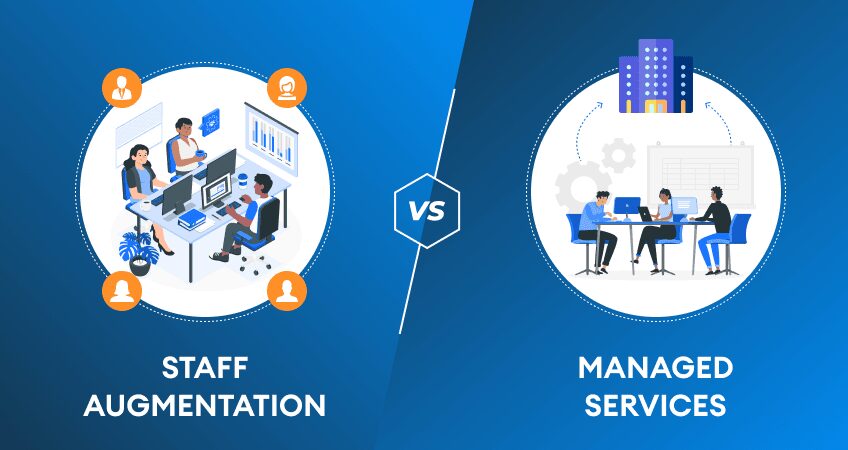
Companies today face critical decisions when outsourcing IT needs. The choice between staff augmentation vs managed services impacts budgets, timelines, and operational control. Global IT outsourcing will reach $541 billion in 2024, proving both models deliver real value.
This comparison explores staff augmentation vs managed services to help businesses optimize costs and results. We examine flexibility, management overhead, cost structures, and ideal use cases. Understanding these differences ensures you select the right approach for your specific requirements.
Understanding Staff Augmentation for Flexible Workforce Scaling

Staff augmentation adds temporary external talent to your existing team. You maintain full control over project management and daily tasks. This model works well for short-term needs or specialized skill gaps.
The key advantage in staff augmentation vs managed services is immediate flexibility. Businesses scale teams up or down based on project demands. Augmented staff integrate directly with your workflows under your supervision.
This approach suits companies needing niche expertise for specific phases. It’s ideal when you require hands-on control but lack certain skills internally. However, management responsibility remains with your organization throughout the engagement.
Advantages and Challenges of Staff Augmentation
The staff augmentation vs managed services debate reveals clear benefits for staffing flexibility. You pay only for needed hours without long-term commitments. Knowledge transfer occurs naturally as external experts work alongside your team.
Direct oversight ensures alignment with company standards and goals. You avoid vendor lock-in and maintain intellectual property control. Staff augmentation often proves cost-effective for well-defined projects with clear timelines.
However, this model requires significant management effort from your team. Onboarding temporary staff takes time and resources. Without proper integration, productivity may suffer during transition periods. Costs can escalate if project timelines extend unexpectedly.
The Managed Services Model for Hands-Off Operations
Managed services transfer entire functions to external providers. The vendor assumes responsibility for delivering agreed-upon outcomes. This represents the opposite approach in staff augmentation vs managed services comparisons.
Service Level Agreements (SLAs) define performance metrics and deliverables. Providers bring specialized infrastructure and processes you might lack internally. This model works best for ongoing operational needs rather than project-based work.
The managed services approach reduces your management burden significantly. Predictable monthly costs simplify budgeting. Access to cutting-edge technology and expertise comes without major capital investments.
Benefits and Limitations of Managed Services
In the staff augmentation vs managed services evaluation, managed services offer operational stability. Providers deliver guaranteed service levels with penalty clauses for underperformance. Your team gains time to focus on core business priorities.
Cost predictability appeals to organizations with consistent operational needs. Providers handle staffing, training, and technology updates automatically. You benefit from economies of scale without infrastructure investments.
However, less control represents the tradeoff. Changing requirements may involve contract renegotiations. Some businesses feel disconnected from outsourced processes. Cultural alignment and communication require careful vendor selection.
Time and Materials Considerations for Both Models
The staff augmentation vs managed services decision heavily impacts time and cost management. Staff augmentation uses hourly or daily rates that fluctuate with project needs. You pay for actual time spent but assume scheduling risks.
Managed services typically involve fixed monthly fees. Predictable costs come with less flexibility for short-term adjustments. Change requests often trigger additional charges in managed service agreements.
Staff augmentation allows real-time adjustments to team composition. Managed services provide stability but less day-to-day adaptability. Your choice depends on whether you prioritize control or convenience.
Making the Right Choice for Your Business Needs
The staff augmentation vs managed services decision depends on specific requirements. Staff augmentation suits project-based work needing specialized skills. Managed services work better for ongoing operational functions.
Consider project duration, required expertise, and management bandwidth. Evaluate whether you need hands-on control or prefer outcome-based delivery. Budget flexibility versus predictability also influences the decision.
Progressive Robot helps companies navigate staff augmentation vs managed services decisions. Our experts assess your needs to recommend the optimal approach. We deliver both models with transparent pricing and measurable results.
Conclusion: Strategic Approach to IT Resourcing
The staff augmentation vs managed services comparison highlights different paths to operational efficiency. Staff augmentation offers control and flexibility for dynamic projects. Managed services provide stability for routine operations.
Successful companies often combine both models strategically. Temporary staff address peak demands while managed services handle core functions. Progressive Robot tailors solutions to your unique business requirements.
Contact us today to discuss the ideal balance for your organization. We’ll help you optimize costs, quality, and operational control through smart resourcing strategies. The right approach delivers competitive advantage in today’s demanding markets.